
Flag Stories
The Colours of Czechia
August 11, 2026
In 1989, Czechs overthrew a regime without breaking a window. They jingled keys in the squares. Ten days, zero shots, one playwright elected president. They called it the Velvet Revolution, and it might be the most stylish political act of the 20th century. That's Czechia for you: quiet, ironic, and always underestimated.
Where it all began
Prague was a European capital when most capitals were fields. Charles IV made it the seat of the Holy Roman Empire in the 1300s and founded Central Europe's first university there in 1348; the bridge he started building in 1357 still carries pedestrians today, and yes, you'll walk it at dawn if you're smart. Bohemia gave Europe an early reformation with Jan Hus a century before Luther, survived defenestrations (they invented the word by doing it, twice), empires and occupations, and split with Slovakia in 1993 so amicably it's literally called the Velvet Divorce. Some countries can't even do breakups well. This one turned it into a brand.
The minds
Franz Kafka wrote his unsettling masterpieces in Prague offices by day. Dvořák's New World Symphony (1893) was Neil Armstrong-approved: a recording flew on Apollo 11. Milan Kundera gave us The Unbearable Lightness of Being. Gregor Mendel, counting peas in a Brno monastery garden in the 1860s, founded the entire science of genetics. Otto Wichterle invented the soft contact lens in 1961, using a kit built from a children's construction set, on his kitchen table, on Christmas Day. And the word robot itself? Coined in Karel Čapek's 1920 play R.U.R. Every robot on Earth speaks Czech at birth.
Made in Czechia
Škoda went from bicycles in 1895 to one of Europe's most respected carmakers. Bohemian crystal has been the world standard for centuries. Pilsner Urquell, brewed in Plzeň since 1842, invented the golden lager that 90 percent of the world's beer now imitates, and Czechs drink more beer per person than any nation on Earth, a title they've held for decades without breaking a sweat. Add precision engineering, aircraft, and one of Europe's strongest game-dev scenes. Not bad for ten million people.
Where to go
Prague, yes, but do it right: Old Town Square and the castle early, then cross the river to Žižkov or Vinohrady where the actual Praguers drink. Brno, the second city, has the café culture and none of the crowds; Mendel's garden is still there.
Then out. Český Krumlov, a Renaissance town wrapped in a river loop, arguably Europe's prettiest small town. Kutná Hora, with a chapel decorated with human bones, stranger and more moving than it sounds. The Moravian wine country around Mikulov, rolling hills, cellars, white wines that deserve more fame. Bohemian Switzerland's sandstone arches. And Karlovy Vary, where Europe has taken the waters for 600 years.
Culture, on a plate and in the ear
Eat svíčková, beef in cream sauce with dumplings and a whipped-cream-and-cranberry twist that sounds wrong and tastes right. Goulash with beer. Koláče with coffee. Christmas means carp, sold live from street barrels, ask a local, it's a whole saga. Listen for Dvořák and Smetana's Vltava, which literally paints the river in sound. And absorb the national art form: dry, deadpan humour delivered with a straight face and a raised glass.
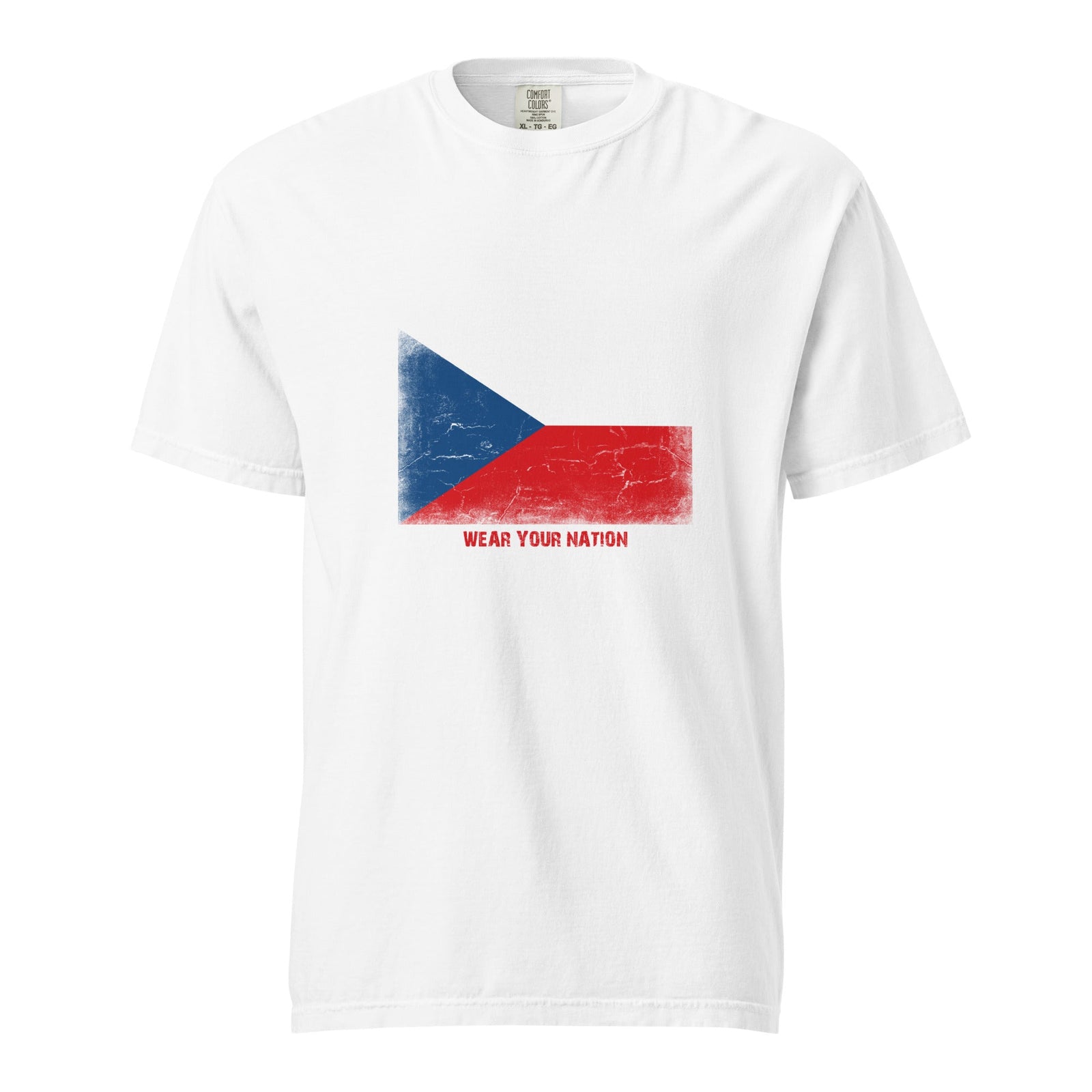
Every colour is someone's home. I print it the way memory keeps it: vintage-washed, distressed, made to order.
Shop the Czechia tee · the hoodie · Travelers · Sleeve Badge
P.S. White, red, and that blue wedge cutting in from the flagpole, added in 1920 so the flag would be nobody else's. It worked. Find your flag.
Get the next story
One flag at a time — early access & new drops included.