
Flag Stories
The Colours of Colombia
August 11, 2026
There is a reason the greatest novel of magical realism came from Colombia. Gabriel García Márquez didn't invent a fantasy world for One Hundred Years of Solitude. He just wrote Colombia down, and the rest of the planet assumed he was making it up.
Where it all began
Before the Spanish came, the Muisca people of these highlands had a ritual: a new chief covered in gold dust, diving into Lake Guatavita while gold offerings sank around him. Spanish soldiers heard the story and spent a century chasing it. That's right, Colombia is the origin of the El Dorado legend itself. The gold was real, by the way; Bogotá's Gold Museum holds 34,000 pieces of it, the finest pre-Hispanic goldwork on Earth. Independence came with Simón Bolívar in 1819 at the Battle of Boyacá, and the country that emerged carries his dream in its DNA: it was the heart of Gran Colombia, the union that once included Venezuela, Ecuador and Panama.
The minds
Gabo, as the country calls him, took the Nobel in 1982 and turned Macondo into a place realer than most real towns. Fernando Botero made volume itself a signature; his generous sculptures stand in plazas from Medellín to Manhattan. Shakira taught the world hips don't lie; Karol G and J Balvin made Medellín a global pop capital. And in science, Manuel Elkin Patarroyo developed the world's first synthetic malaria vaccine candidate in the 1980s and handed the patent to the WHO. There's a pattern here: Colombia gives its best things away.
Made in Colombia
Start with the obvious: coffee. Grown high and slow on volcanic slopes by half a million families, so good UNESCO listed the entire Coffee Cultural Landscape in 2011. Then the less obvious: Colombia supplies most of the world's emeralds, including the finest ever cut; it's one of Earth's top flower exporters, that Valentine's bouquet almost certainly flew out of Bogotá; and its textile scene in Medellín dresses half of Latin America. Two oceans, three Andean ranges, more bird species than any country on the planet. The land itself is the portfolio.
Where to go
Cartagena, a walled Caribbean city of balconies and bougainvillea where every sunset looks staged. Medellín, the comeback story of the century, ride the Metrocable over the hills and see a city that chose to reinvent itself. Bogotá for the Gold Museum, street art and the best restaurants between the two oceans.
Then the Colombia Colombians brag about. The Cocora valley, where wax palms, the tallest palms in the world, stand 60 metres over green hills. Barichara, the prettiest colonial town nobody visits, all stone streets and silence. The Lost City trek, four days through jungle to a citadel older than Machu Picchu. Caño Cristales, the river of five colours, which between June and November genuinely runs red, yellow, green and blue thanks to aquatic plants. And Providencia, a Caribbean island so laid-back it makes the rest of the Caribbean look stressed.
Culture, on a plate and in the ear
Eat a bandeja paisa and cancel your afternoon. Arepas everywhere, ajiaco in Bogotá, lulo juice because the fruit exists almost nowhere else. Dance, you have no choice: cumbia is the mother rhythm, vallenato the accordion heartbeat, salsa in Cali, which calls itself the world capital of the dance and backs it up nightly. And learn the phrase that explains the country's warmth even after its hardest decades: que hubo, parcero. Roughly: what's up, friend. Everyone is parcero here.
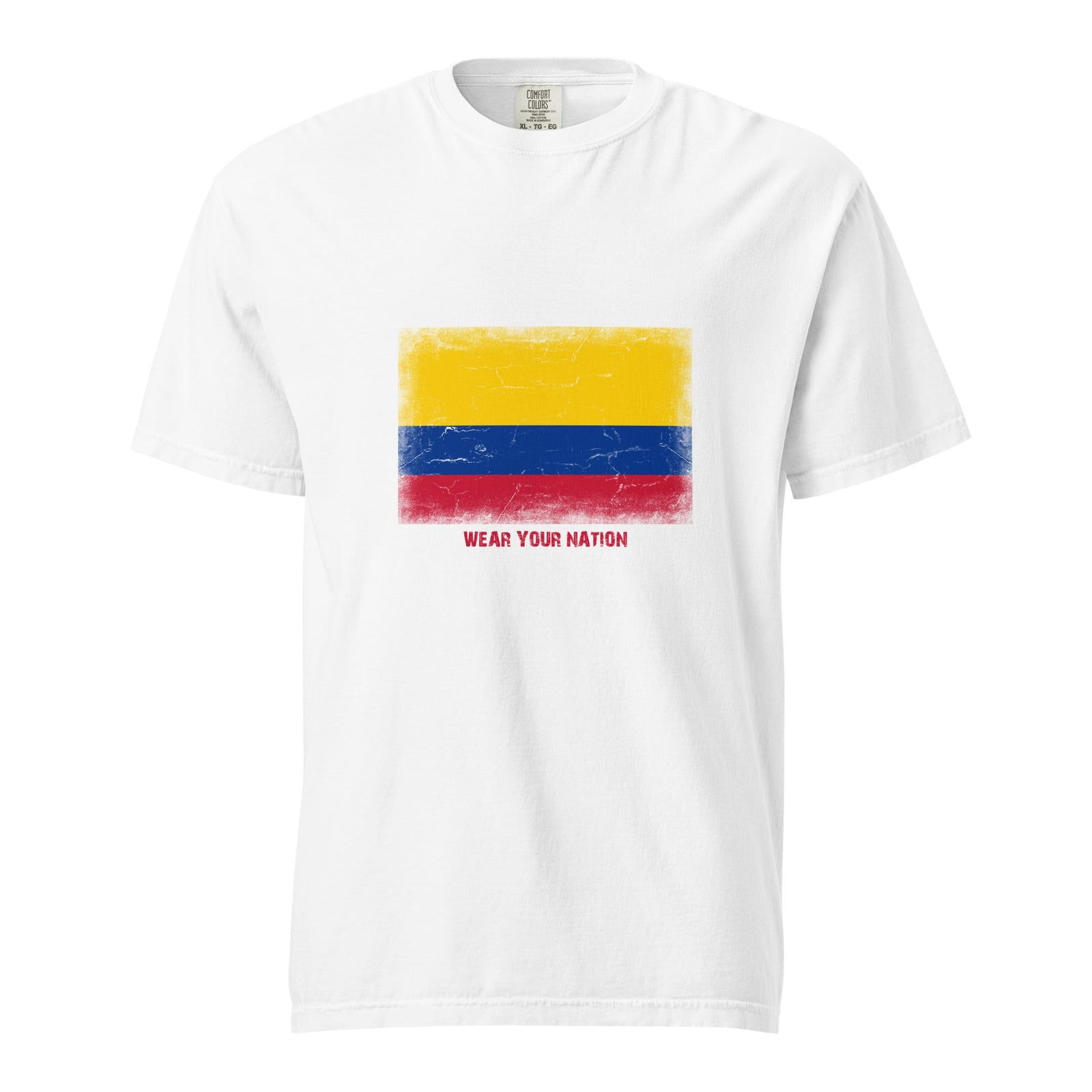
Every colour is someone's home. I print it the way memory keeps it: vintage-washed, distressed, made to order.
Shop the Colombia tee · the hoodie · Travelers · Sleeve Badge
P.S. Yellow for the gold, blue for the two seas, red for the price of freedom. Half the flag is yellow on purpose. Find your flag.
Get the next story
One flag at a time — early access & new drops included.