
Flag Stories
The Colours of Haiti
August 11, 2026
On 1 January 1804, something happened that the great powers of the world had sworn was impossible: enslaved people rose, defeated Napoleon's armies, and founded their own nation. Haiti is the only country in human history born from a successful slave revolution. Whatever you think you know about Haiti, start there. Everything else is footnotes to that thunderclap.
Where it all began
The Taíno called the island Ayiti, land of high mountains, and Haiti kept the name in their honour. The French made it the richest colony on Earth; the people made it free. Toussaint Louverture out-generalled three empires; Dessalines finished the job at the Battle of Vertières in 1803. And then Haiti kept exporting freedom: it gave Simón Bolívar ships, guns and men in 1816 on one condition, that he free the enslaved wherever he won. South America's liberation carries a Haitian signature. To guard the newborn nation, King Henri Christophe built the Citadelle Laferrière on a 900-metre peak, the largest fortress in the Americas, UNESCO-listed, and still one of the most awe-inspiring structures in the hemisphere.
The minds
Haiti's imagination punches globally. The painters of the Cap-Haïtien and Saint-Soleil schools hang in world museums; Haitian art is one of the planet's great naive-art traditions, colour with a heartbeat. Writers carry the torch: Jacques Roumain's Masters of the Dew is a Caribbean classic, Dany Laferrière sits in the Académie française, and Edwidge Danticat's books win prizes in two languages. Wyclef Jean took Haitian sound to the top of the global charts. And Haitian Creole itself, forged by the people, is a full literary language spoken by over ten million, a monument you can hear.
Made in Haiti
Haitian vetiver from the fields around Les Cayes anchors a huge share of the world's perfumes; that expensive fragrance you know almost certainly contains Haiti. Rhum Barbancourt, distilled in Port-au-Prince since 1862, is one of the world's most respected rums. Add cacao and coffee from mountain smallholders that specialty roasters fight over, mangoes (the Francique is legendary), and metal art from Croix-des-Bouquets, where oil drums are hammered into intricate sculpture sold worldwide.
Where to go
When conditions allow, and check carefully, they change, Haiti rewards like nowhere else. Cap-Haïtien and the climb to the Citadelle, with the ruined Sans-Souci palace below, the Versailles of the Caribbean. Jacmel in the south, a town of gingerbread houses, artists' workshops and a UNESCO-listed carnival of papier-mâché masks. The Bassin Bleu waterfalls above it, three turquoise pools in the jungle. Île-à-Vache off the south coast, beaches with no billboards. And Labadee's green cliffs on the north shore.
Culture, on a plate and in the ear
Eat griot, twice-cooked pork with pikliz, the spicy slaw that improves everything, diri ak djon djon, rice black with native mushrooms, and soup joumou every 1 January: the squash soup the enslaved were forbidden to taste, eaten now on Independence Day by every Haitian on Earth. UNESCO lists it as heritage. A soup as a declaration of freedom. Music is constant: kompa for dancing close, rara horns in the streets at Easter, twoubadou guitars at dusk. And the national spirit in one proverb: Ayiti pap peri. Haiti will not perish. It hasn't. It won't.
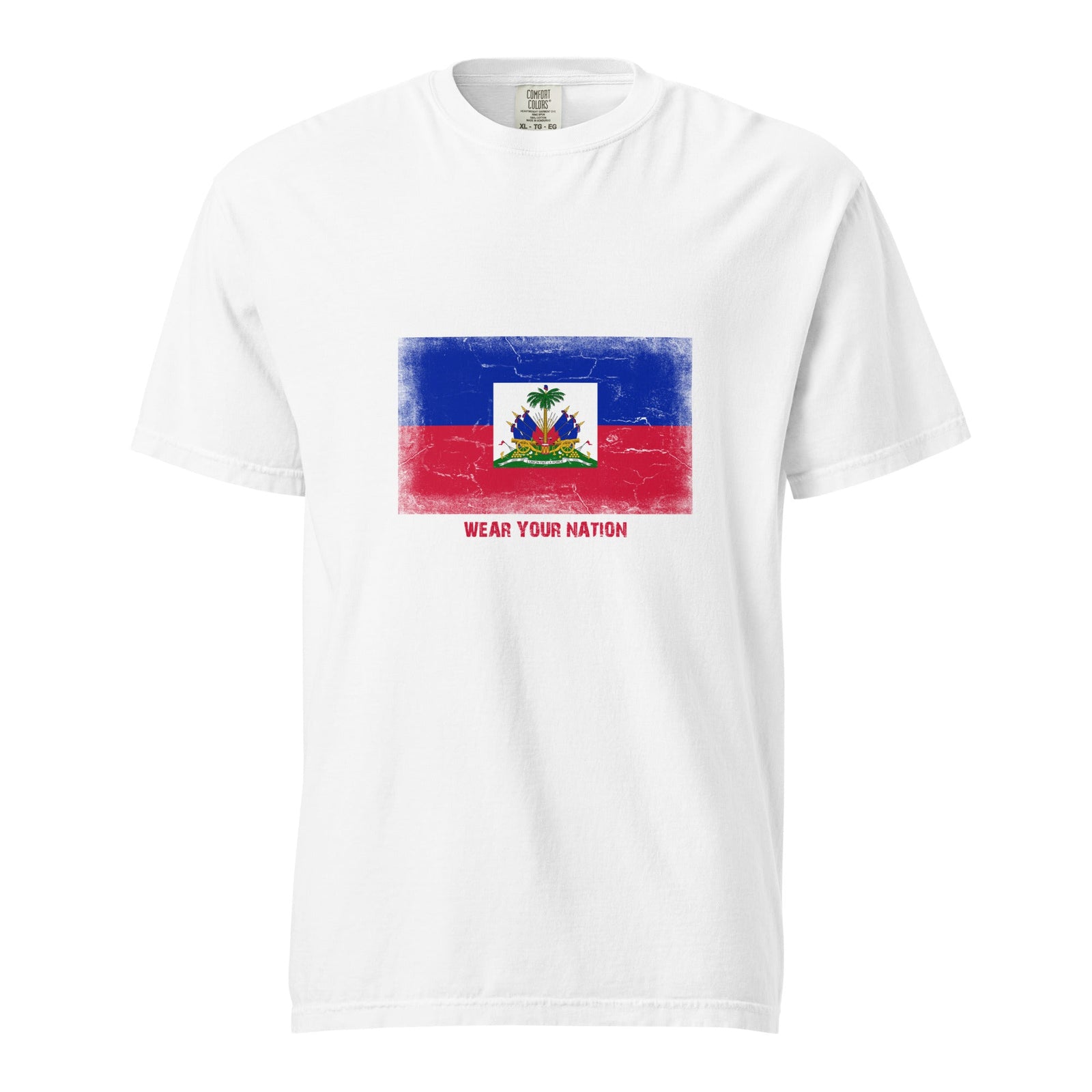
Every colour is someone's home. I print it the way memory keeps it: vintage-washed, distressed, made to order.
Shop the Haiti tee · the hoodie · Travelers · Sleeve Badge
P.S. Legend says Dessalines made the flag by tearing the white band out of the French tricolore and stitching blue to red. History as scissors. Find your flag.
Get the next story
One flag at a time — early access & new drops included.