
Flag Stories
The Colours of Cape Verde
August 11, 2026
There's a word the Portuguese language gave the world: saudade. The beautiful ache for something far away. Cape Verde didn't just inherit the word. Ten volcanic islands, 500 kilometres out in the Atlantic, with more Cape Verdeans living abroad than at home. This is the country that turned missing home into an art form.
Where it all began
The islands were uninhabited until the Portuguese arrived in 1462, and what grew here was one of the world's first truly Creole societies: African and European blood, language and music mixed on ships and in ports. Cidade Velha, the old capital on Santiago, was the first European colonial town in the tropics, UNESCO-listed today. Independence came in 1975, and then Cape Verde did something rare: it became one of Africa's most stable democracies, changing governments peacefully like it's the most normal thing in the world. On this side of the Atlantic, that's a flex.
The minds
One name first: Cesária Évora. The barefoot diva from Mindelo, who sang morna in smoky bars for decades before the world caught on when she was past fifty. Her Grammy came in 2004, and her voice remains the sound of longing itself; the airport on São Vicente carries her name. Around her, a whole musical nation: Cape Verde has possibly more musicians per capita than anywhere, and morna itself entered UNESCO's heritage list in 2019. The poet Eugénio Tavares wrote the mornas everyone still sings. Not bad for half a million people on ten rocks.
Made in Cape Verde
The sea and the sky do the heavy lifting: tuna fisheries, salt from the old pans of Sal (the island is literally named Salt), and a growing wind and solar sector, the trade winds never stop, so why not use them. Grogue, the sugarcane spirit, is distilled the way it was 200 years ago. But the biggest export is people, and the biggest import is their return: remittances, visits, and songs mailed home.
Where to go
Each island is its own country. Sal and Boa Vista for beaches that out-Caribbean the Caribbean, kitesurfers treat them as holy ground. Santiago for history in Cidade Velha and the highland markets. São Vicente for Mindelo, the cultural capital, live music every night and a carnival in February that Brazilians respect.
Then the wild ones. Fogo, where a volcano rises 2,829 metres straight from the sea, and people grow wine inside the caldera, on black lava, next to the cone that erupted as recently as 2014. Chã das Caldeiras wine, drunk where it grew, is a bucket-list item nobody told you about. And Santo Antão, whose green ribeiras and cliff paths are some of the best hiking in the Atlantic. The ferry from Mindelo takes an hour. Take it.
Culture, on a plate and in the ear
Eat cachupa, the slow corn-and-beans stew that every family makes best (ask three people, get three winners). Fresh tuna, lobster on the beach, a shot of grogue after. Then the music, always the music: morna for the ache, coladeira for the joy, funaná for the dance floor. And the national motto in practice: no stress. Said constantly. Meant completely.
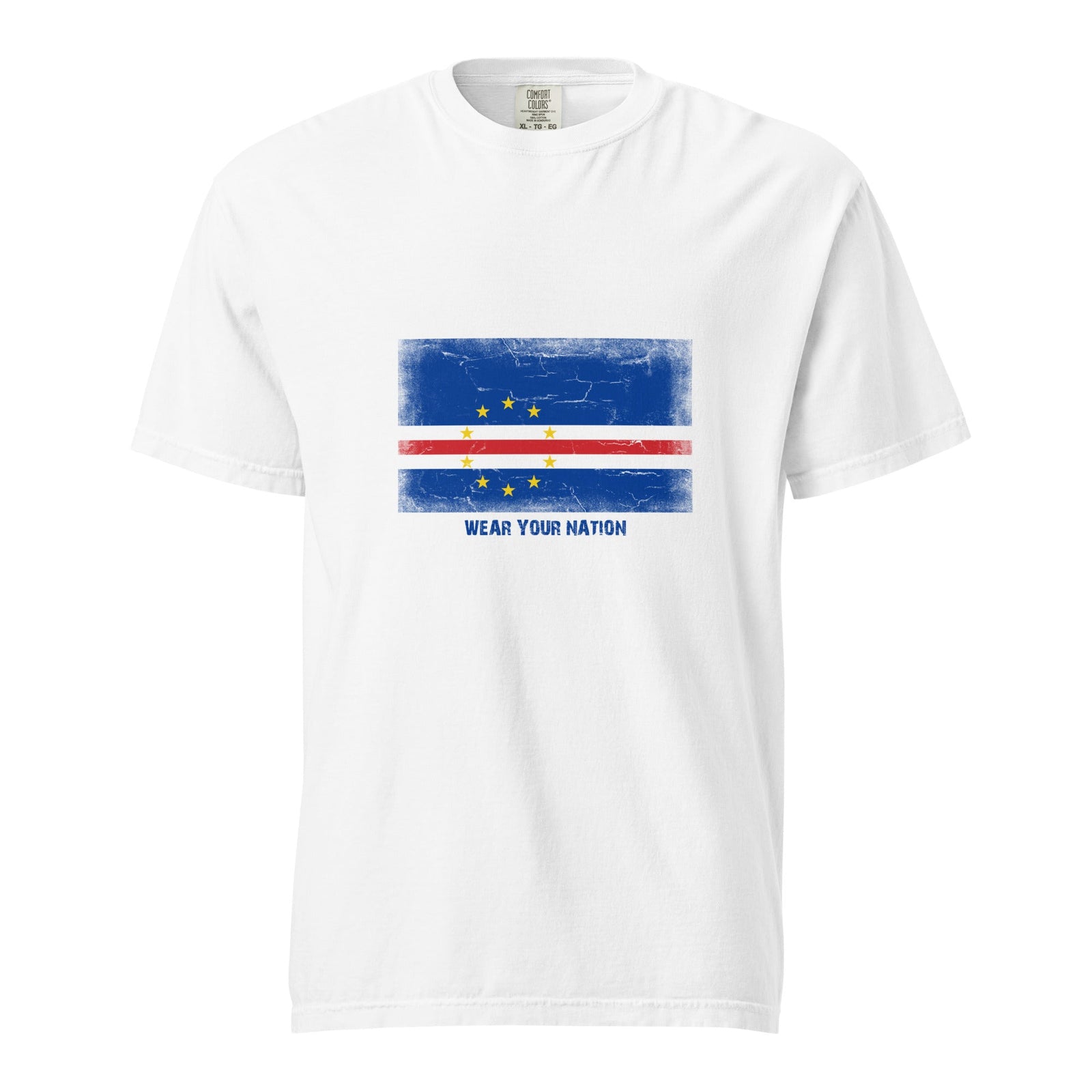
Every colour is someone's home. I print it the way memory keeps it: vintage-washed, distressed, made to order.
Shop the Cape Verde tee · the hoodie · Travelers · Sleeve Badge
P.S. The circle of ten stars on the blue? One for each island, floating on the Atlantic. Home, even from far away. Especially from far away. Find your flag.
Get the next story
One flag at a time — early access & new drops included.