
Flag Stories
The Colours of Jordan
August 11, 2026
Two thousand years ago, desert traders carved an entire city into rose-coloured cliffs, complete with a water system that made a desert bloom, and then history simply misplaced it for centuries. When you walk the narrow Siq canyon and Petra's Treasury suddenly fills the gap in the rock, you will make a sound you didn't plan to make. Everyone does. That's Jordan's welcome.
Where it all began
The Nabataeans built Petra as the crossroads of the incense routes, taxing caravans of frankincense and silk, and their engineering, dams, cisterns, channels cut in stone, still humbles modern hydrologists. Rome left one of its grandest provincial cities at Jerash, colonnades nearly intact. Lawrence of Arabia rode through Wadi Rum in the 1916 Arab Revolt, whose flag inspired Jordan's own. The modern kingdom, founded as an emirate in 1921 and independent in 1946, has managed something rare in its neighbourhood: decade after decade of stability, and doors kept open, Jordan hosts millions of refugees with a grace larger than its size.
The minds
This land reads like a footnote index of civilisation: the Dead Sea Scrolls were found on its sea's shores; Bethany-beyond-the-Jordan, the baptism site on the river, is UNESCO-listed; and Umm Qais looks over three countries from its Roman theatre of black basalt. Modern Jordan's export is expertise: its doctors, engineers and academics staff the region, its film crews host Hollywood, Wadi Rum has played Mars in The Martian, Dune and half of science fiction, because when NASA needs Mars on Earth, it books Jordan. Queen Rania made global education advocacy a royal job description.
Made in Jordan
From the Dead Sea, the lowest point on Earth at about 430 metres below sea level, come the potash and minerals in fertilisers and cosmetics worldwide; that mineral mud mask in your bathroom is probably Jordanian. Phosphates, pharmaceuticals from Amman's labs, olive oil from trees centuries old, and Medjool dates from the Jordan Valley that win international contests. Plus one of the region's liveliest tech scenes: Amman startups sold to Silicon Valley put the city on the map, locals call it a quiet MENA tech hub.
Where to go
Petra needs a full day minimum, two is right: the Siq at 6 a.m. before the crowds, then the 800-step climb to the Monastery, bigger than the Treasury and half as visited. Wadi Rum next: jeep through red dunes, tea with Bedouin hosts, sleep in a camp and see the Milky Way as your ancestors did. The Dead Sea to float, you cannot sink, reading a newspaper is the classic photo, and the mud is free spa.
Then the parts people miss. Jerash, one of the best-preserved Roman cities anywhere. Amman's downtown: Roman theatre, hummus at Hashem, where kings and taxi drivers eat the same plate, and gallery-filled Jabal Al Weibdeh. Madaba's 6th-century mosaic map of the Holy Land. Mount Nebo, where Moses saw the promised land. Dana Biosphere Reserve, canyon hiking from highlands to desert. And Aqaba's Red Sea reefs to finish underwater.
Culture, on a plate and in the ear
Mansaf is the answer: lamb in fermented jameed yoghurt over rice, eaten from a communal platter, the national dish and a ceremony of welcome. Maqluba arrives flipped upside-down at the table, applause optional but common. Knafeh, hot cheese under crisp semolina and syrup, ends every argument. Cardamom coffee poured in small cups carries its own etiquette: shake the cup to say enough. And the word you'll hear hourly: ahlan wa sahlan. Welcome. In Jordan it's not a phrase, it's the operating system.
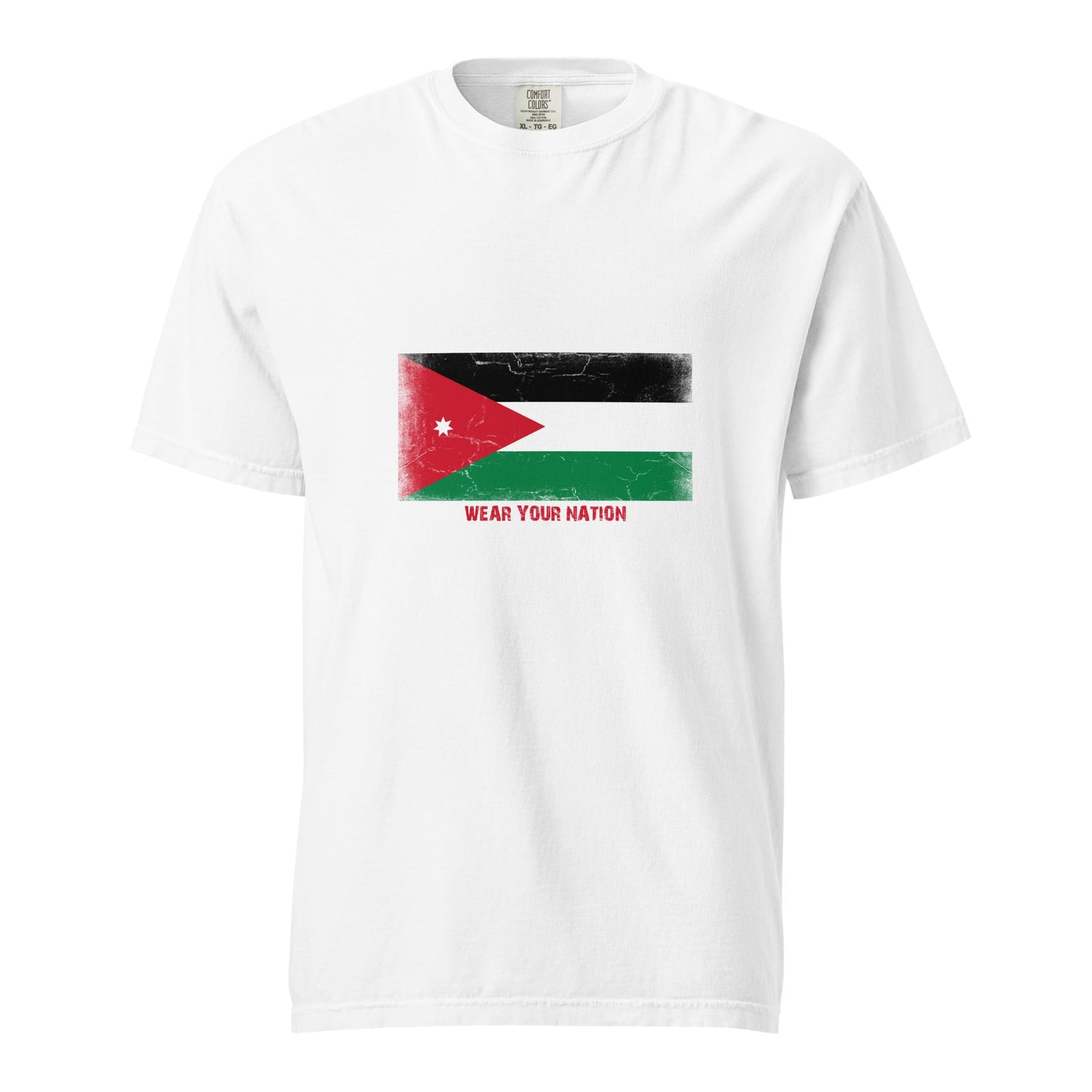
Every colour is someone's home. I print it the way memory keeps it: vintage-washed, distressed, made to order.
Shop the Jordan tee · the hoodie · Travelers · Sleeve Badge
P.S. Black, white and green for the great Arab dynasties, red for the revolt that birthed the kingdom, and the seven-pointed star of the opening verses of the Quran. A flag that reads like a history book. Find your flag.
Get the next story
One flag at a time — early access & new drops included.