
Flag Stories
The Colours of Bosnia and Herzegovina
August 11, 2026
There's a bridge in Mostar that tells you everything about Bosnia and Herzegovina. Built in 1566 by an Ottoman architect, a single stone arc so elegant engineers still study it. Destroyed in 1993. Rebuilt, stone by stone, some pulled from the river, and reopened in 2004. Some countries put their story in books. Bosnia put its into a bridge: beauty, loss, and the stubborn decision to rebuild.
Where it all began
This is where East and West have shared an address for centuries. Medieval Bosnia had its own kings and its own church; the Ottomans brought minarets and bazaars from the 1460s; Austria-Hungary added trams and facades in the 1880s. Sarajevo is the only major European city where, within a few hundred metres, you'll pass a mosque, a Catholic cathedral, an Orthodox church and a synagogue, all historic, all in use. And yes, on a corner near the Latin Bridge in June 1914, a single pistol shot set off the First World War. Few small countries have stood so squarely in history's path.
The minds
Ivo Andrić won the Nobel Prize in Literature in 1961 for The Bridge on the Drina, a novel that is basically this country's soul in 300 pages. Sarajevo's film festival, started in 1995 while the city was still under siege, grew into one of Europe's most respected, that fact alone deserves a moment of silence. Danis Tanović's No Man's Land took the Oscar for best foreign film in 2002. And in 1984, Sarajevo hosted the Winter Olympics; you can still ski the same mountains, Jahorina and Bjelašnica, for a fraction of Alpine prices.
Made in Bosnia
Craft here is old and serious. Coppersmiths have hammered coffee sets in Sarajevo's Baščaršija for five centuries; the sound is the soundtrack of the old town. The country exports furniture and timber across Europe, runs serious hydropower on its wild rivers, and quietly makes car parts for half the continent's brands. And the water: Bosnia is one of Europe's richest countries in pure spring water, which locals consider entirely normal and everyone else considers a miracle.
Where to go
Sarajevo first: drink Bosnian coffee, properly, from the copper džezva, no rushing, in Baščaršija, then walk the Austro-Hungarian avenues one street over and feel the century change under your feet. Mostar for the bridge and the divers who leap 24 metres into the Neretva, a tradition since 1664.
Then the country most visitors never reach. Blagaj, where a dervish house has clung to a cliff above a spring since the 1400s. Počitelj, a stone town folded into a hillside. The Kravice waterfalls, the Balkans' answer to a small Niagara, swim under them in summer. Lukomir, the highest village in the country, where shepherds still live at 1,470 metres. And the Una river, so green it looks colour-graded.
Culture, on a plate and in the ear
Eat ćevapi in somun bread with kajmak, and accept that the argument over Sarajevo versus Banja Luka style has no end. Burek, which here means meat pie only, everything else is just pita. Then sit for sevdah, the Bosnian blues, songs of love and longing that hang in the air like smoke. There's a word for the feeling: merak, the slow enjoyment of small pleasures. This country, which has every reason to hurry, chooses merak. Learn from it.
Every colour is someone's home. I print it the way memory keeps it: vintage-washed, distressed, made to order.
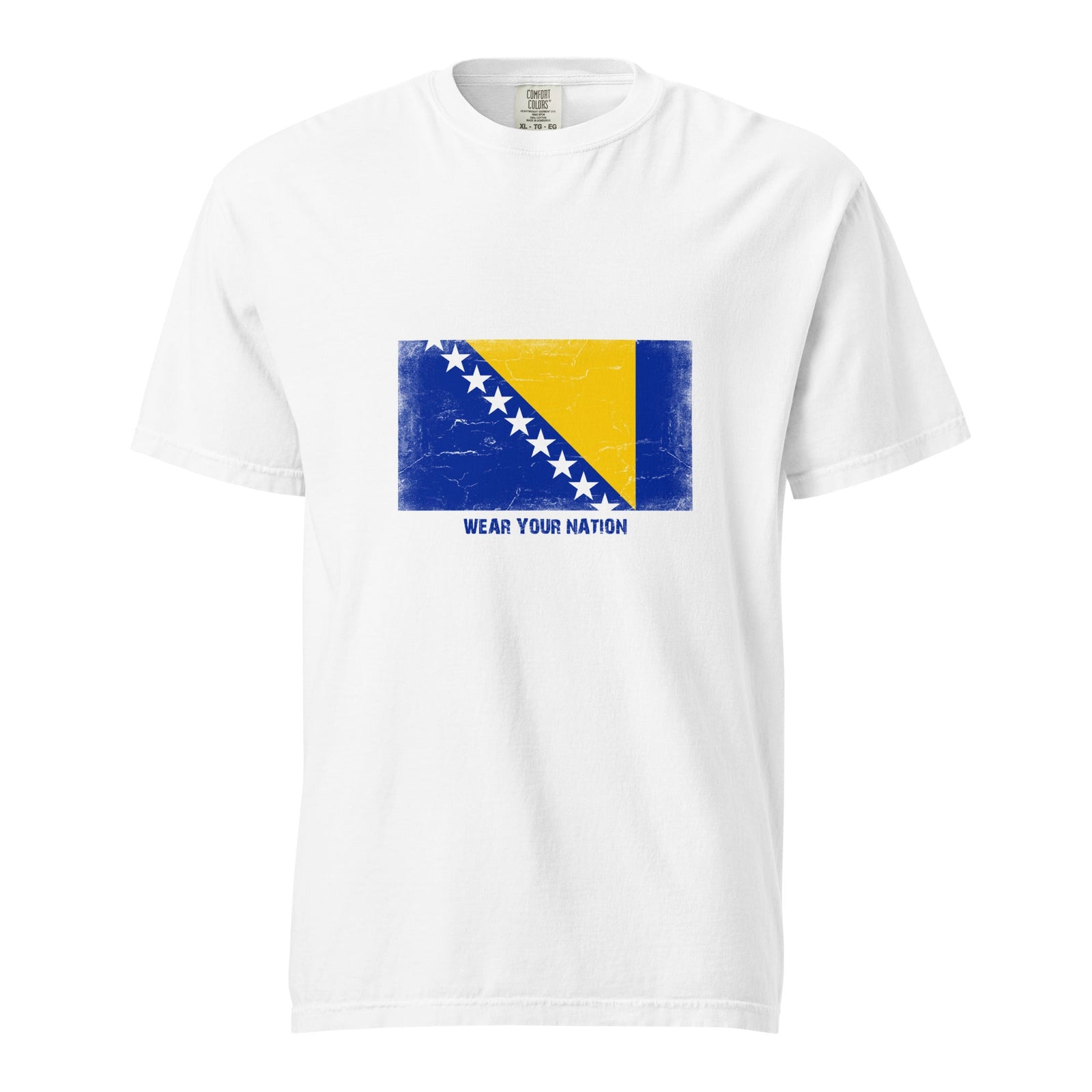
Shop the Bosnia tee · the hoodie · Travelers · Sleeve Badge
P.S. Blue and gold with a line of stars, and the triangle for the country's three peoples. A flag about geometry instead of blood. That was the point. Find your flag.
Get the next story
One flag at a time — early access & new drops included.