
Flag Stories
The Colours of Côte d'Ivoire
August 11, 2026
You have probably eaten Côte d'Ivoire this week. Maybe today. This one West African country grows around 40 percent of the world's cocoa. Every second chocolate bar on Earth, statistically speaking, started as a pod on an Ivorian tree, picked by hands that most chocolate eaters will never think about. Let's think about them for a minute.
Where it all began
The land between the lagoons and the savanna held old kingdoms, the Baoulé, whose queen Abla Pokou is said to have led her people across a river at unbearable cost, and traders whose gold weights are now museum treasures. The French coast of "ivory" became independent in August 1960 under Félix Houphouët-Boigny, who ran the country for 33 years and built, in his home village of Yamoussoukro, the largest church on Earth: the Basilica of Our Lady of Peace, consecrated by the Pope in 1990, taller than St Peter's in Rome. In the middle of the bush. You have to see it to believe it, and even then.
The minds
Ivorian creativity travels. The writer Ahmadou Kourouma won France's biggest literary prizes with novels that made French bend to Malinké rhythms. Alpha Blondy took reggae, added Dioula and French, and filled stadiums from Abidjan to Paris; Magic System's "Premier Gaou" (1999) remains one of Africa's most famous songs ever, you've danced to it whether you know it or not. Coupé-décalé, invented by Ivorians in the 2000s, conquered the continent's dance floors. And in football, Didier Drogba didn't just score goals: his public plea in 2005 is widely credited with helping pause a civil war. A striker who stopped a war. Let that sink in.
Made in Côte d'Ivoire
Cocoa first, the world's largest producer by far, plus cashews (also world number one), coffee, rubber, cotton and bananas. Abidjan is the economic capital of French-speaking West Africa, banks and startups stacked along the lagoon, and the port of San-Pédro ships more cocoa than any port on the planet. The next chapter is making the chocolate at home, not just growing it, and Ivorian brands are starting to do exactly that.
Where to go
Abidjan, the "Manhattan of the tropics", skyline over the Ébrié lagoon, maquis restaurants where the braised chicken comes with attieke and the music never apologises. Grand-Bassam, the old colonial capital on the beach, UNESCO-listed, an easy day trip. Yamoussoukro for that impossible basilica and the sacred crocodiles.
Then the green interior. Man, the city of 18 mountains, with its rope bridges of vine, waterfalls and mask dancers of the Dân people. Taï National Park, one of the last great primary rainforests of West Africa, where chimpanzees crack nuts with stone tools, a culture they teach their young. And Assinie's endless beach, where Abidjan goes on weekends to forget the week.
Culture, on a plate and in the ear
Eat attieke with everything; it's cassava couscous and it's perfect. Alloco (fried plantain) from a street stand, garba with tuna if you want to eat like a student, kedjenou chicken slow-steamed in a clay pot if you want to eat like a grandmother cooked for you. Then follow the sound: zouglou from the campuses, coupé-décalé from the clubs, reggae from the record shops. The national talent is joy under pressure. They even have a word for making a party out of nothing: ambiance. Côte d'Ivoire is ambiance, industrial grade.
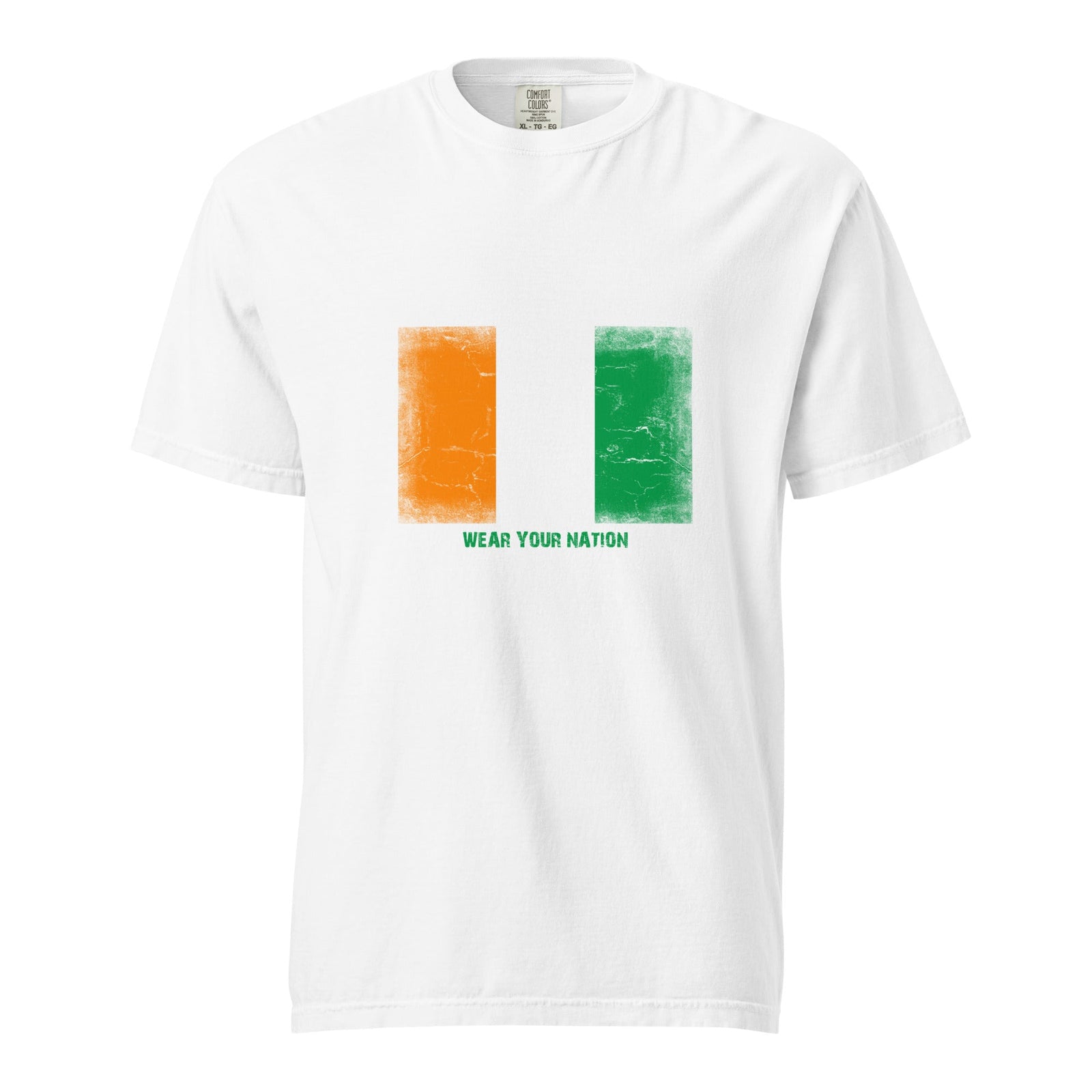
Every colour is someone's home. I print it the way memory keeps it: vintage-washed, distressed, made to order.
Shop the Côte d'Ivoire tee · the hoodie · Travelers · Sleeve Badge
P.S. Orange for the savanna, white for peace, green for the forest. France's tricolore mirrored and repainted in African light. Find your flag.
Get the next story
One flag at a time — early access & new drops included.