
Flag Stories
The Colours of Congo
August 11, 2026
Put your finger on the heart of Africa's map and you'll touch the Congo, a country the size of Western Europe, wrapped around a river so massive it pushes fresh water a hundred kilometres out into the Atlantic. Most people know almost nothing about it. Which is wild, because the modern world literally runs on this place.
Where it all began
Long before Europeans arrived, the Kingdom of Kongo ran diplomacy, trade routes and its own currency across this region from the 1300s; its kings exchanged ambassadors with Lisbon and letters with the Vatican. The colonial chapter that followed was one of history's darkest, and Congolese know their history precisely; it's part of the pride. Independence came on 30 June 1960 with Patrice Lumumba, whose name still echoes across the continent. Through every hard decade since, the country's answer has been the same: music, faith, and a refusal to stop dancing.
The minds
Start with the sound. Congolese rumba, listed by UNESCO in 2021, is the rhythm an entire continent moves to, and its royalty is Congolese: Franco and his OK Jazz, Tabu Ley Rochereau, Papa Wemba, king of the sapeurs, who proved you can dress like a Paris runway on a Kinshasa street, and today Fally Ipupa filling arenas worldwide. In 2018 the Nobel Peace Prize went to Dr Denis Mukwege, the surgeon of Bukavu, one of the most admired physicians alive. And the wildlife science is unique on Earth: the bonobo, our closest relative along with the chimp, lives only here. So does the okapi, the forest giraffe so improbable Europeans dismissed it as a myth until 1901.
Made in Congo
Check your pocket. The phone in it almost certainly contains Congo: the country produces around 70 percent of the world's cobalt and much of its coltan, the minerals every battery and circuit board depends on, plus copper from Katanga and diamonds from Kasai. The Congo River holds some of the greatest untapped hydropower potential on the planet at the Inga rapids. And the forest, the world's second-largest rainforest, breathes for all of us. This is not a footnote country. It's infrastructure for the whole modern world.
Where to go
Kinshasa, the largest French-speaking city on Earth, bigger than Paris, louder than anywhere: river views across to Brazzaville (the only place two capitals face each other over a river), studios where the rumba is recorded, markets that never fully close. Then the Congo River itself, where barges travel for weeks like floating villages.
For the brave and well-prepared: Virunga, Africa's oldest national park (1925), home of the mountain gorillas and the Nyiragongo volcano, whose crater holds the world's largest lava lake, a two-day climb to look into the planet's open heart. Lola ya Bonobo near Kinshasa, the only bonobo sanctuary in the world. The Zongo falls a day trip from the capital. Check conditions carefully, go with the right people, and you'll see things almost nobody alive has seen.
Culture, on a plate and in the ear
Eat liboke, fish steamed in banana leaves, with fufu and pondu (cassava leaves), and something grilled from a roadside brazier at midnight. Watch the sapeurs promenade on Sundays, elegance as an act of defiance. And give the music the whole evening: rumba into ndombolo, guitars like falling water. There's a saying about this country: the Congo will break your heart and then teach it to dance. Both parts are true.
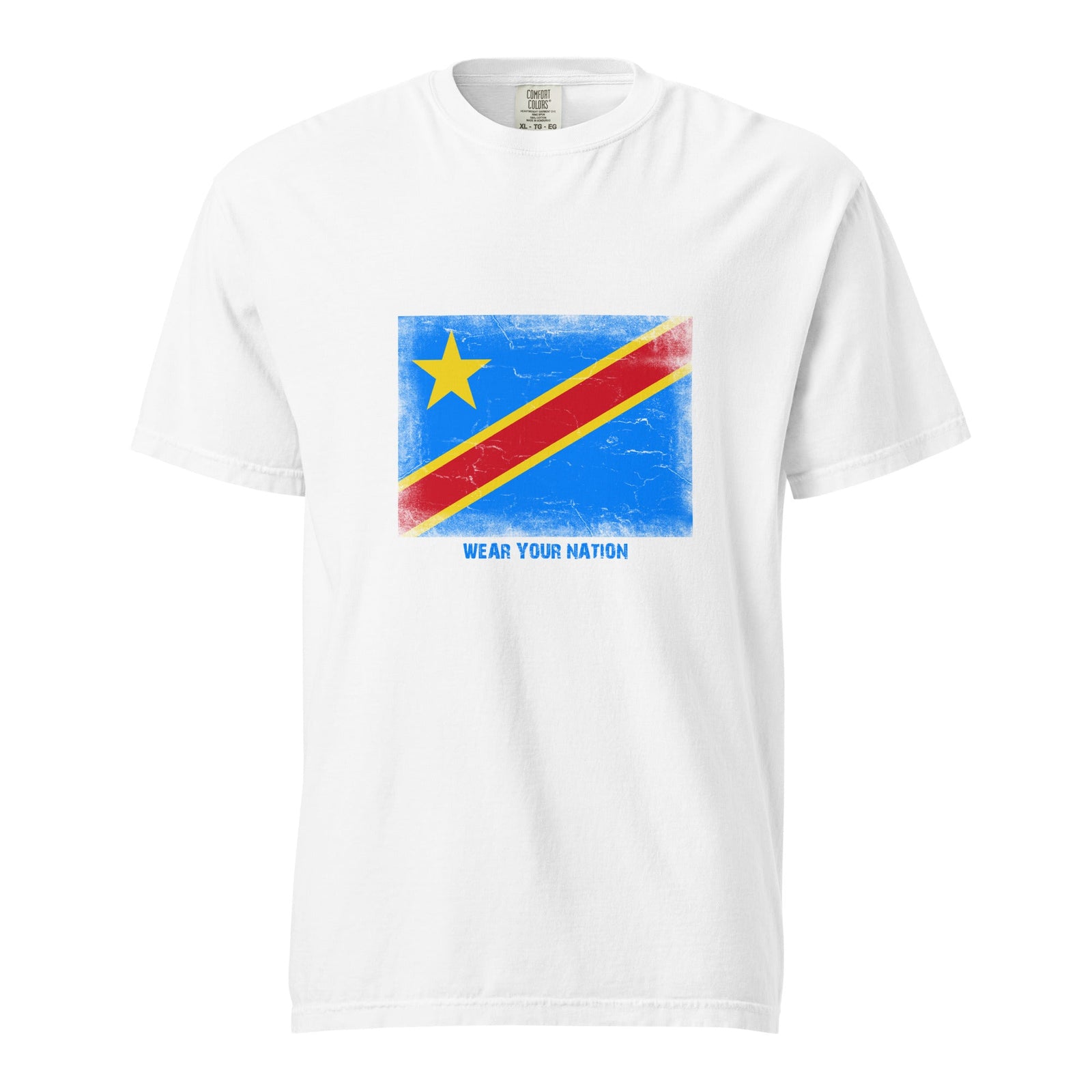
Every colour is someone's home. I print it the way memory keeps it: vintage-washed, distressed, made to order.
Shop the Congo tee · the hoodie · Travelers · Sleeve Badge
P.S. Sky blue for peace, one gold star for unity, and the red stripe for the price already paid. A flag that looks forward on purpose. Find your flag.
Get the next story
One flag at a time — early access & new drops included.